Dear Felienne!
I need to start with a confession: I have a secret history of breaking things at work. My destructive streak started early, at primary school, when I destroyed the blackboard just after turning seven. Ok, maybe “destroyed” is a bit of an overstatement, but somehow I thought it would be funny to coat the entire blackboard with a layer of hand soap so the teacher’s chalk would no longer write on it. (I spent the entire weekend cleaning the board with the help of my mother; but yes, the other kids had fun.) Also later, while doing my first internships and when finally working ‘for real’, I quickly became known as the one who causes software to crash, drops her phone repeatedly, and ruins her new laptop on day one.
This, however, does not mean I am a Luddite. In fact, most of these ‘incidents’ were the result of (1) painful boredome mixed with childish curiousity (the soapy blackboard), (2) above-average clumpsiness (dropping devices), (3) raw emotions getting the better of me (crying right onto the keyboard of my new laptop in frustration until too much liquid leaked inside), or (4) my extraordinary impatience (nervously clicking buttons in computer interfaces one hundret times in a row as fast as possible will make a suprising amount of software hang or crash). Yet, while I truly am a master at breaking things, I do not recall breaking anything with political, social, or good intentions.
Of course, I agree with core values of the Luddite movement, such as human dignity, economic justice, and labor autonomy at work. Sure, I talk critically about AI, big tech, and how digitalization affects us. But unfortunately, this does not make me a Luddite. Why not? Well, let me tell you about this poem I love by Frank O’Hara. It is from 1957, titled “Why I Am Not a Painter”1 and starts with the words “I am not a painter, I am a poet. Why? I think I would rather be a painter, but I am not.” In the poem, Frank O’Hara admiringly describes how his painter friend Mike Goldberg is working on a painting called “Sardines”2 that initially features some sardines, but that ultimately ends up without any sardines on it (I have included an image below). He contrasts this with his own creative process. Thinking about the color “orange”, he finds himself writing lines and more lines, then pages and more pages because "[t]here should be so much more, not of orange, of words, of how terrible orange is and life.” When he is done, he has finished a bundle of 12 poems called Oranges, but he hasn’t even mentioned “orange” yet!
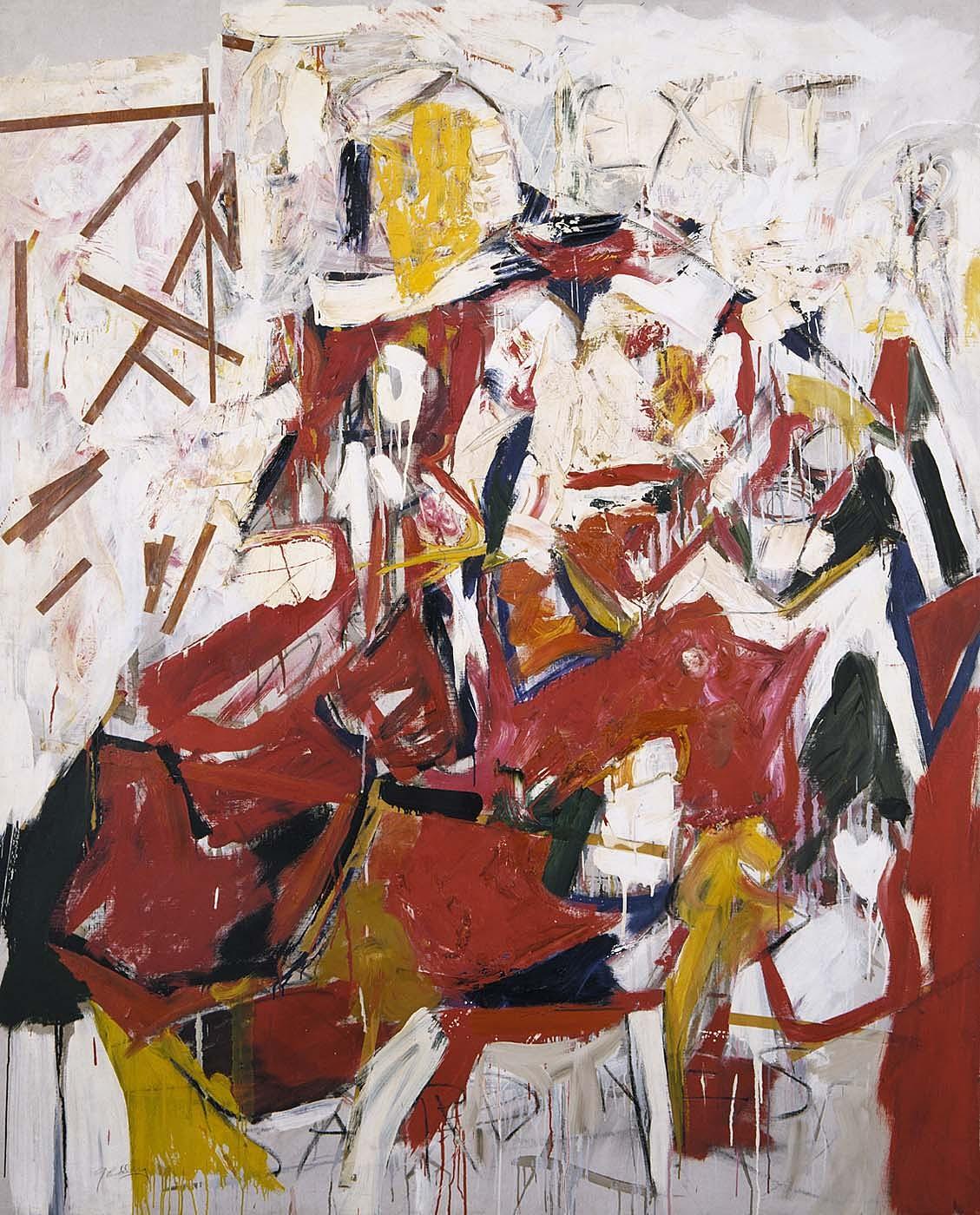
I am neither a poet nor a painter, so how does this explain why I am not a Luddite? Well, I believe parts of me would rather be a Luddite in the exact same sense as Frank O’ Hara would have rather been a painter. But I am no Luddite. I am the person who chooses words over deeds and thoughts over actions. One of my absolute favorite novelists, Jenny Offill, has this amazing sentence in her book “Dept. of Speculation” (2014)3, where she writes, “She thinks before she acts. Or more properly, she thinks instead of acts. A character flaw, not a virtue.” This is me. I’d rather be a Luddite, but I think instead of act!
But then again, I also believe that things (including me) can change. So I decided that this time things would be different. This homework would not be about my thoughts and words. No longer would I type, delete, revise, and retype sentences; instead, I would finally choose to act. And I did…sort-of!
What did I do? Breaking things at work would have been obvious, right? But I do this all the time anyway, so no one might have noticed. Also, I have to admit I did not dare to do so. Hence, I needed to think of — no, I needed to do something else. I definitely wanted to provoke some colleagues who believe we should watch out for becoming Luddites and instead embrace AI. In the end, maybe because we talked so much about the weavers and their cloth, I felt inspired to make some t-shirts that boldly depict the word “Luddite”. And spoiler alert: they turned out great (I have included a picture of those below too). Unfortunately, while wearing the resulting shirts might suggest that I am a Luddite, their very existence further proves that I am not. Let me explain…
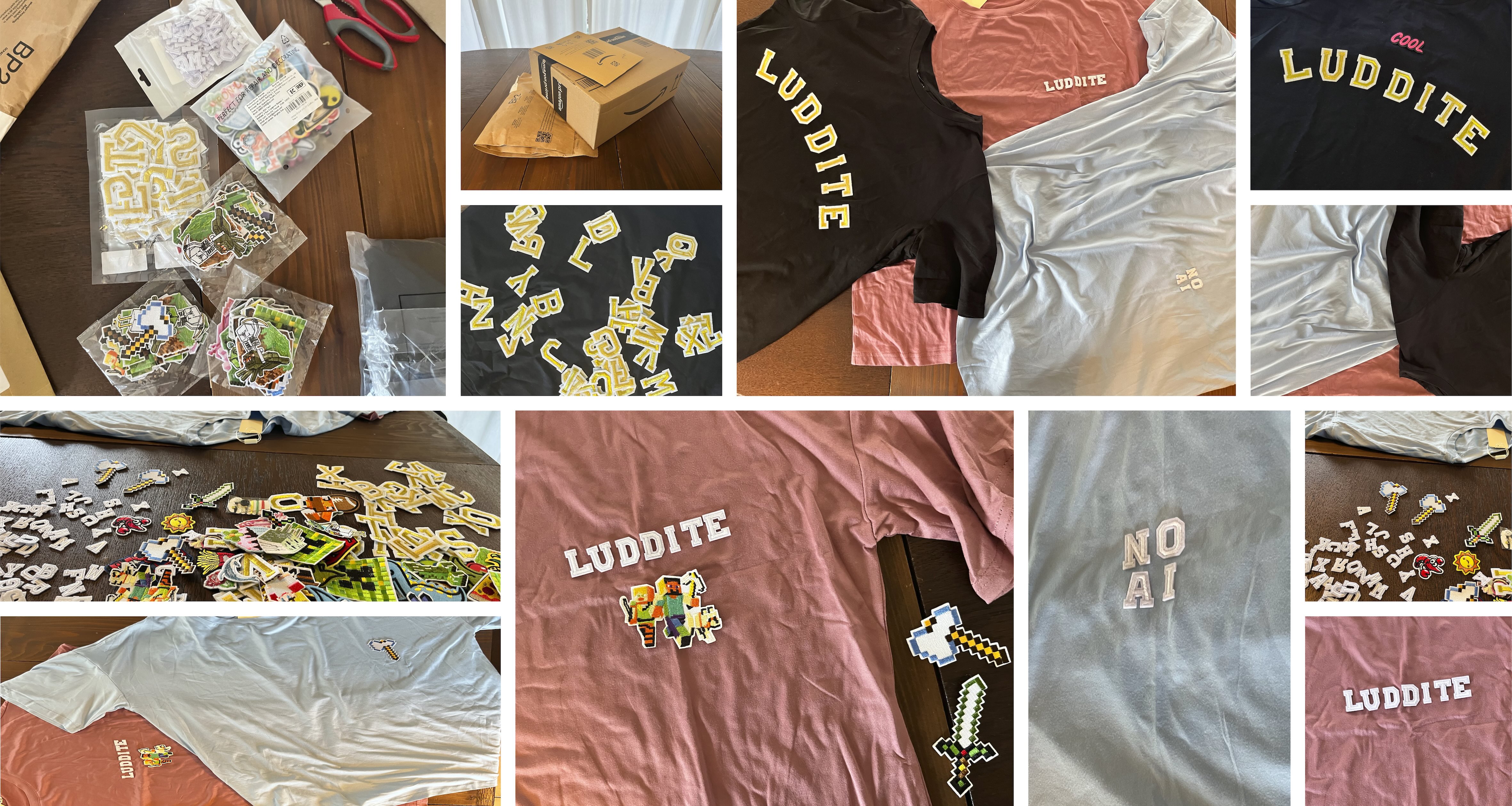
My first piece of evidence suggests that I am a hypocrite rather than a Luddite. Namely, to ‘make’ those shirts, I just ordered some plain shirts and iron-on patches on Amazon. No, indeed, no sewing machine was involved. Also, I have no idea how to use one. And yes, I ordered the shirts on Amazon. And that’s while I could have reused an old shirt instead. And yet, some part of me believes I hate Amazon and Big Tech.
Then, to make things worse, I also ordered rather cheap shirts. After all, they were meant just to make a point, as a provocation — not as a piece of clothing I would wear all the time. I think I paid 50 bucks for the entire bundle. I don’t even want to know what kind of working conditions are necessary to keep these shirts that cheap. If you were to ask me, I am definitely not okay with those conditions — yet, somehow I bought the shirts!
Now here we are, with the cheap shirts in my washer, probably worn out before I even put them on just once. That’s not the product quality that the Luddites were fighting for. If that does not prove I am a hypocrite, I am not sure what else would. But just in case you are still doubting: I kind of ‘mass-produced’ these shirts. Instead of just making one shirt (which would have sufficed to make my point), I quickly created three. I even thought of quick, tiny, boring, and repetitive steps that could be carried out on each subsequent shirt to make the process more efficient… So much about opposing Taylorism!
And another confession: when I said I ‘made’ shirts because I wanted to provoke colleagues and carry the term “Luddite” proudly on my chest, what I really-really meant to say is that I pretended to make shirts. In reality, I distributed these ready-made iron-on letters “L”,”U”,”D”,”D”,”I”,”T”,”E” on the shirts and took pictures to document how these shirts could look. To be clear, I did not even bother to iron those letters on. After all, these days, having the pictures for a story is enough. Why would I go through the trouble of creating real things if I already have an image that I can share with folks online? So, indeed, there are no t-shirts; it’s all been one big scam. Don’t worry, though; I am sure those pictures will do to get us likes on LinkedIn, and they should also suffice to illustrate this homework post.
Wait, what? You believe I used AI to create those pictures? NO! I might not be a Luddite, but even I would not go that far. The shirts, patches, and pictures — those are real. Do you not believe me? Ok, fine, I’ll iron the patches on and wear the shirt to work — just to prove that you are wrong. I will proudly wear the shirt proclaiming that I am a Luddite, while secretly doing my best not to break more things at work. In fact, now that I think of it, wearing the term as a fashion statement rather than taking real action could be quite fitting for someone who prefers to think rather than act?
I know I promised that this time things would be different, that this week I would act instead of think. But in the end, I couldn’t help myself. So here are my thoughts on whether I am a Luddite: No, I am not a Luddite who breaks things, as I prefer using words over other weapons. But I am convinced that thoughts and words do matter. In fact, a main worry I have about AI is that LLMs change not just what we do but also what we say, how we say it, how and what we write, and what and how we think!!! So maybe these days I can call myself a Luddite — not for breaking things at work — but because I choose my own words and thoughts and reject those suggested by LLMs?
Oh, no: Now this piece of writing has reached a natural conclusion, and I haven’t even mentioned “capitalism” yet. Well, let’s just say that capitalism sucks — but if you want to order my self-made t-shirts, I’ll make you a special prize, my friend! What about 50 bucks per shirt?
Cheers,
Hanna
-
O’Hara, F. (1957). Why I am not a painter [Poem]. See: https://poets.org/poem/why-i-am-not-painter ↩︎
-
Goldberg, M. (1955). Sardines [Painting]. Smithsonian American Art Museum, Washington, DC, United States. See: https://americanart.si.edu/blog/eye-level/2012/30/685/why-i-am-not-painter-michael-goldbergs-sardines ↩︎
-
Offill, J. (2014). Dept. of Speculation. Granta Books. ↩︎